

Very early counting tools known as abacuses were used as early as 300 B.C. in Babylon (modern-day Iraq). The first gear-driven counting tool was Schickard’s calculating clock, invented in 1623. A few years later, a calculator — able to add, subtract, multiply, and divide — was developed by the famous scholar Gottfried Wilhelm Leibniz, who also developed calculus, binary numbers, and many important ideas in philosophy and logic. (Blaise Pascal also invented a calculator during this era.)
With binary, inventors were able to use punch card systems for the first electronic computers. International Business Machines (IBM) would later take this technology and make it available for more widespread uses. More about the beginnings of IBM can be found on the company’s history page.
To meet missile guidance demands during World War II, IBM and Harvard University teamed up to create the Harvard Mark I, a mechanical computer eight feet tall and fifty-one feet wide. This was the first modern computer. Columbia University features detailed photographs and more information on their Mark I history site.
Hewlett-Packard (HP), a technology company started in 1939, developed its first computer in 1966. The HP 2116A, as it was called, was a controller for several different instruments. In 1974, HP developed a memory processing system that used dynamic random access memory chips (DRAM), as opposed to the magnetic cores that were popular. The HP history page details the entire history of the company.
The first personal computer was available in 1975: the MITAS Altair computer. It came in a box and had to be assembled by the purchaser. PC History has the complete history of the Altair on their website. This was the computer that inspired Harvard freshman Bill Gates to drop out. The first Apple computer, the Apple I, was available a year later. The history of Apple Computers can be found on the Apple History website.
After the Apple I, personal computers became smaller, easier to use, and more powerful by leaps and bounds, though . In 1977, Paul Owen and Bill Gates started the Microsoft Company. GamePlayer has written up the complete history of Microsoft, spanning from the birth of Bill Gates in 1955 through to September 2008.
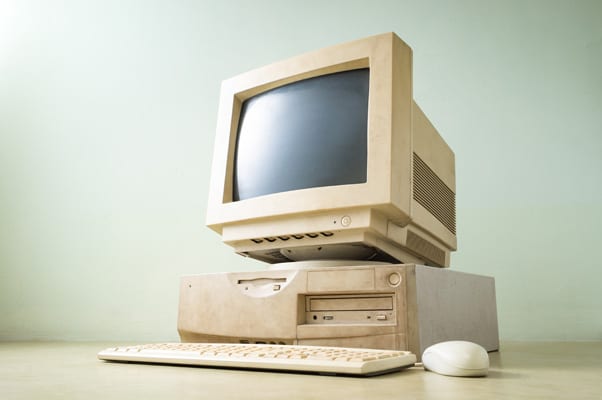
In 1981, Osborne Computers released the Osborne 1 computer, considered to be the first consumer laptop. It weighed 24.5 pounds and cost $1,795. Once manufacturers began developing smaller and smaller technology, the personal computer revolution really took off. Several new computer models came out each year, each one more powerful than the ones before. Once the size of a whole room, the home computer now fit easily on a small desk.
There are several places to view the evolution of computer technology. The Computer History Museum is located in Mountain View, California, part of the famous Silicon Valley. The University of Virginia also has a computer museum, with pictures of some of the exhibits on their website along with links to other computer museums.
Here are some great websites with information about computer history:
- Computer History: A complete history of the early computer, starting with abacuses and ending in the early 1980s. This site has pictures of almost every piece of technology mentioned.
- History of Computers: A resource list with links to over 100 websites about the history of the computer, programs and uses, and important developers.
- Islandnet.com: A complete history of the personal computer, in timeline form.
- ComputerHistory.org: Another timeline, sorted by decade, company, people, games, or several other categories.
Knowing and understanding the history of the modern computer makes it clear how amazing these machines are
Meeting Tomorrow provides consumers and business people with such solutions as: laptop rental solutions, tv rental solutions, and printer rental solutions. If you’re in the market for any kind of av rental, let us know how we can help!
Related Articles: American Sign Language in Business | Planning a Technical Conference | PowerPoint Templates